Fulani Daughters Don't Have This Problem. A 74-Year-Old Market Woman in Kaduna Told Me Why — And It Changed My Daughter's Hair in 30 Days

I want you to do something with me before you read another word.
Close your eyes for a moment and picture the Fulani women you have seen in your life. At the market. By the roadside. At a naming ceremony in the north. Moving through the city with that particular ease that comes from a life lived mostly outdoors.
Now picture their daughters.
Have you ever really looked at those girls' hair?
Full. Thick. Natural. Long. Retained at lengths that make you wonder — what are they doing that we are not doing? What do they know that we don't? What product are they using? What specialist are they seeing?
The answer is none. No product. No specialist. No YouTube tutorial. No deep conditioning treatment. No growth serum in a beautiful bottle with a price that makes you wince.
They are not doing anything special.
They are just eating.
And it took a seventy-four-year-old Fulani woman sitting behind a calabash of fura da nono at Kasuwan Barci market in Kaduna to make me understand what that means — and why my daughter's hair had been breaking and refusing to grow for four years while Fulani daughters' hair thrived without effort.
What she told me that Wednesday morning did not just change my daughter's hair.
It changed the way I understand what hair actually is. Where it actually comes from. And why everything I had been doing — everything most Nigerian mothers are doing — was solving the problem in completely the wrong location.
This is not a story about a product. It is a story about finally understanding why the products never worked — and what does.
Look at the Difference. Then Ask Why.
Before I tell you what Hajiya Rakiya told me, I want you to sit with something.
Because I spent four years assuming the difference between Fulani daughters' hair and my daughter's hair was genetic. Different hair type. Different heritage. Something structural that I simply could not change.
It is not genetic. Look at what is actually different between those two childhoods.
- Liver and organ meats eaten regularly — ordinary weekday food
- Fura da nono daily — fermented millet and milk, extraordinarily iron and zinc dense
- 30+ minutes of direct outdoor sun every day — nomadic life means outside life
- Bone broths and wild-caught fish appear consistently in the diet
- Whole animal eaten — nothing wasted, including the most nutrient-dense parts
- Golden Morn, white bread, instant noodles as daily staples
- Chicken — lower in zinc than red meat — as default protein
- Indoors from 7am to 8pm — school, lessons, homework, screens
- Liver considered old-fashioned — rarely appears on the table
- Supplements bought from pharmacy — addressing one nutrient at a time
This is not a judgment. This is a description of how our lives have changed in one generation — and what that change has quietly done to what our daughters' hair follicles receive every day.
Iron. Zinc. Vitamin D.
The three nutrients the hair follicle needs most. The three nutrients Fulani children receive automatically through their traditional diet and outdoor life. The three nutrients most Nigerian children in cities are quietly running out of — not dramatically, not visibly, but consistently enough that the follicle is producing a fraction of what it is capable of.
That fraction is the hair that breaks.
But I am getting ahead of myself. Let me take you to Kaduna first.
Kasuwan Barci Market, Kaduna. A Wednesday Morning.
The market was already full when we arrived. My cousin had brought me to find fabric — she knew the best stalls, the ones her mother had used for thirty years. Temi was with me, holding my hand, her eyes moving everywhere the way children's eyes do in markets — taking in the colour, the noise, the movement.
She saw the calabash before I did.
A large, beautiful calabash painted in the traditional Fulani way, sitting on a low table beside an elderly woman who was watching the market the way very old people sometimes watch things — not looking for anything in particular, just seeing everything clearly.
Temi pulled my hand. She had never tried fura da nono. I had no reason to say no.
So we stopped. And that stopping changed everything.
Hajiya Rakiya was seventy-four years old. She had been selling fura da nono at that market for forty years. Her mother had sold it before her. Her grandmother before that. There was a quality to her stillness that I noticed immediately — the kind that comes from someone who has been in the same place, doing the same thing, watching the same world pass by, for long enough to understand things that moving people miss.
While she prepared the drink, she looked at Temi's hair.
Not rudely. Not the way people sometimes look — with the expression that makes you want to cover your child and walk away. She looked the way a farmer looks at a plant. Reading something. Assessing. Her eyes moved slowly — the crown, the temples, the hairline, the section at the back that I had pushed forward that morning to hide the thinness there.
She caught me watching her look.
She handed Temi the drink. She watched her taste it — the slight surprise on Temi's face, then the acceptance, then the pleasure. Then she looked at me.
I said yes. Standing there in the noise of Kasuwan Barci, I said yes.
I had not told her anything. She had simply looked.
What She Said Next Is What I Have Been Trying to Tell Every Mother I Know Ever Since
She paused. She looked at Temi one more time. Then she said something else — the sentence I want every mother reading this to hear.
I found my cousin forty minutes later. I had not moved from that stall.
I had seven pages of notes on my phone and something I had not felt in four years of products and specialists and Facebook groups and ₦200,000 spent on solutions that never reached the root.
I had an explanation that made everything make sense.
Why Everything You Have Tried Has Not Fixed It
Let me explain what Hajiya Rakiya was describing in a way that will make the last four years of your experience suddenly click into place.
Your daughter's hair follicle is a living factory buried three to four millimetres beneath her scalp. Every strand of hair that emerges on the outside was built inside that factory — long before it became visible to you. The factory runs on three specific raw materials delivered through the bloodstream: iron (to oxygenate the cells doing the building), zinc (to construct the keratin structure that gives each strand its strength), and Vitamin D (to signal the factory to move from resting mode into active production).
When the body detects that its supply of these three nutrients is insufficient, it makes a biological priority decision. The heart, the brain, the immune system are funded first. The hair follicle — considered non-essential — is funded with whatever remains. In most Nigerian children eating a modern urban diet with minimal sun exposure, what remains is very little. The factory slows down. It produces thinner strands with structural gaps built into them at the moment of construction. These strands break not because of how you comb or style or what you apply — but because they were built without enough material to be strong.
The three deficiencies do not work independently. They form a loop that reinforces itself: low iron impairs zinc absorption; low zinc prevents Vitamin D from being activated in the body; low active Vitamin D disrupts iron metabolism. The loop rebuilds the shortage from three directions simultaneously. This is why addressing one nutrient at a time — one supplement, one dietary change, one new product — produces partial results that fade. The loop continues from the two points you did not touch.
Fulani children are not in this loop. Their traditional diet — fura da nono, liver, organ meats, outdoor sun exposure — breaks all three points of the loop simultaneously, automatically, without anyone planning it. Their hair is the proof that when the loop is broken, the factory produces what it is actually capable of.
The Fulani Root Protocol™ is that loop broken — translated into a thirty-day Nigerian kitchen system that any mother in any city can follow. You do not need fura da nono. You need what fura da nono delivers. And this guide shows you exactly how to deliver it.
The Three Pillars of the Fulani Secret
Hajiya Rakiya did not use words like "iron" or "zinc" or "Vitamin D." She spoke in food and sun and seasons. But what she described maps precisely onto three things that nutritional science has confirmed — and that the Fulani way of life provides without anyone trying.
Fura — fermented millet balls blended with nono, the soured cow milk that Fulani women have drunk for generations — is one of the most iron and zinc-dense foods on this continent. The fermentation process that gives it its distinctive sour taste also breaks down phytates — the compounds in grains that block mineral absorption — making the iron and zinc inside far more available to the body than the iron and zinc in unfermented cereals like Golden Morn or Quaker Oats. Every morning, without thinking about it, Fulani children receive what most Nigerian children in cities are consistently not getting from their breakfast.
Cattle herders eat cattle — the whole animal, not just the prime cuts. Liver appears on the Fulani table twice or three times a week as ordinary food, not a special occasion. Liver is the single most zinc and iron-dense food available at any Nigerian market. The zinc it delivers is what the follicle uses to build the keratin structure of each strand. Without enough zinc, that structure has gaps — invisible, unfelt, but real. The strand that emerges looks like a strand, grows like a strand, and breaks like paper the moment tension is applied. This is the strand your daughter has been growing for years. Not because her hair is broken. Because the zinc to build it properly was never consistently there.
Nomadic life is outdoor life. Fulani children do not sit in classrooms from dawn to dusk. They do not spend evenings under artificial light with a phone or a television. They are outside, under direct equatorial sun, for significant portions of every day. High-melanin skin — the beautiful dark skin our daughters have — requires significantly more sun exposure than lighter skin to produce adequate Vitamin D. Fulani children receive it naturally. Our daughters, moving between school and lessons and indoor evenings, often do not. And without Vitamin D, the follicle's Vitamin D receptors — the ones that signal it to move from resting into active growth — sit quiet. The follicle rests when it should be producing. The hair that emerges is the output of a factory running below capacity.
My Name is Grace Ayodele. And I Spent Four Years Not Knowing This.

I am not a trichologist. Not a nutritionist. Not a specialist of any kind. I am a mother from Ibadan who spent four years and close to ₦200,000 trying to solve a problem she did not understand in a location where it could not be solved.
My daughter Temi's hair grew to a certain point and broke. Every month. The same length, the same way, the same sound of the comb catching on strands that should not have been there.
I bought every product the natural hair community recommended. I joined three different Facebook groups. I paid ₦15,000 for a specialist in Victoria Island who examined Temi's hair for eight minutes, told me it was "fine," and sold me a treatment kit that did nothing.
I tried biotin. I tried deep conditioning treatments. I tried protective styles that were supposed to retain length. I changed her shampoo. I bought a silk pillowcase. I learned terms like "low porosity" and "protein overload" and applied that knowledge carefully and consistently.
Nothing held.
The hair grew. It broke. It grew. It broke. Like a door that opened just wide enough to see what was on the other side — and then swung shut before I could walk through.
And not once — not one specialist, not one Facebook group, not one YouTube creator, not one product — ever asked me what Temi was eating for breakfast.
Hajiya Rakiya asked me in the first five minutes.
Then There Was the Other Thing. The Thing I Had Almost Stopped Talking About.
I want to speak to a specific group of you now. The ones who nodded along to the breaking story but are sitting with something else alongside it. Something more private, more visible, more impossible to hide.
The edges.
The hairline at the temples. The front. The places where the hair should be present and full and layable — and instead is sparse, fragile, barely there. The places that make certain hairstyles impossible. The places you have been covering, compensating for, working around, for months or years.
For a long time, Temi wore one hairstyle.
Not because I lacked creativity. Not because I did not try other things. I tried. And every time I tried, the same truth presented itself: the hair structure — the fragile temples, the sparse edges, the hairline that had been thinning since she was five — simply did not allow it. The style that required edges to be there, to respond, to hold — it did not work, because the edges were not there to give it what it needed.
So we returned to the same style. Safe. Reliable. The one that hid what was not there without drawing attention to the hiding.
She never complained. That was the thing that lived in my chest like a stone. She never said anything. She wore what I gave her and said thank you and went to school and I would watch her go and feel something I did not have a name for.
Hajiya Rakiya looked at those temples before she said a single word to me.
Last in, last out.
I have thought about those four words every day since that market in Kaduna.
What Happened When I Came Home and Started
I want to be honest with you about the timeline. Because one of the most important things Hajiya Rakiya said was: patience is part of the method. The body did not become depleted in a week. It will not restore in a week. Give it the right inputs and then give it time.
I followed the protocol exactly. I checked Temi's hair every morning the way I had been checking it for four years — looking for breakage, looking for the temples, looking for any sign of change. There was none. I almost stopped on Day 3. I remembered Hajiya Rakiya's face and I kept going.
Not the edges. Not yet. But the hair overall felt different at the root when I ran my fingers through it during moisturising. Slightly more substantial. Like something that had been thin was becoming less thin. I told myself I was imagining it. I kept going.
The combing session after wash day was different. Not dramatically. But the sound was different. The floor had fewer strands. I stood in the bathroom after I finished and I counted them. Fewer. I said nothing to anyone. I kept going.
I measured. The hair was longer than it had been at the start of this month. For the first time in two years, the hair I had grown was still there at the end of the fortnight instead of on the bathroom floor. I sat down on the edge of the bath and I held my own face for a moment.
I was doing Temi's nighttime routine. My finger passed over her right temple — the one that had been almost bare for two years — and I stopped. Something was there. So fine I could barely feel it. So new it had no length to speak of. But there. Present. Alive. I turned on the full bathroom light and I looked for a long time.
I attempted a style I had not tried on Temi in three years. A style that required edges — real edges, responsive edges, edges that would hold what I placed there and stay through a school day. I did it slowly. I finished it. I turned her to the mirror. She looked at herself. She touched her own hairline — the temples that had come back enough that the style worked, that it held, that it looked the way it was supposed to look. She said nothing for a moment. Then she said: "Mummy, can we do this one every Sunday?"
Every Sunday. Not once. Every Sunday. From the child who had worn one hairstyle for three years and never once complained about it.
What specifically changed by Day 30:
- The hair retained past the point where it always used to break — for the first time in four years
- The combing sessions went from leaving a small pile of strands on the floor to leaving almost none
- The temple edges grew back enough to allow styles that had been impossible for three years
- Temi's teacher sent a message to the class parent group asking what I had changed
- Temi stopped wearing the same hairstyle every day — because now there were other options
- I stopped dreading Sunday mornings
What Happened When I Told Other Mothers
I kept this to myself for almost two months. Testing. Making sure what I was seeing was real and not another temporary improvement that would reverse itself.
Then a mother in my WhatsApp group posted about her daughter's edges. She wrote three sentences — quiet, almost apologetic — about how she had tried everything and was beginning to accept that the hairline would just always be like that.
I messaged her privately. I told her what Hajiya Rakiya had told me. I shared the protocol.
She started that Monday. She called me on Day 21. She was not speaking normally. She was the kind of person who does not cry easily and she was not crying easily.
She said: "Grace, her temples."
That was all she said for a moment. Just those two words. And I understood completely.
"Four years of thin edges. Four years of the same hairstyle because nothing else worked with what was there. I have spent money I am genuinely embarrassed to calculate. On Day 19, I ran my finger along her left temple and felt something I had not felt in four years. By Day 30, both temples had visible growth. For the first time. My mother came to visit last week. She held Temi's head and looked at me like I had done something impossible. I just smiled. Grace, thank you. I don't have other words than thank you."
"My issue was the breaking, not so much the edges. Hair growing to the same length and breaking at the same point, month after month, for two years. I measured it monthly — I have a record. The month before I started this protocol, the measurement at the end of the month was the same as the measurement at the beginning. The month I followed the protocol, the end measurement was longer than the start measurement. That has not happened in two years. That one difference — hair growing and staying grown — is what I have been trying to buy for ₦5,000 to ₦10,000 a month for twenty-four months."
"Both problems at the same time — breaking and edges. I had actually started to believe this was just how her hair was. The protocol addresses both because they come from the same cause. The breaking responded around Day 10. The edges around Day 22. On Day 30 I put her in a style I had not tried in three years. She looked in the mirror and she smiled at what she saw. That smile. That is what this guide costs. And it is worth every naira."
"I grew up in Kano. I know fura da nono. I have drunk it since I was small. What I never understood was WHY it worked the way it does — what it was delivering to the body that made such a difference. This guide explains it in plain language. Once I understood the why, I could follow the protocol even for the days my daughter refused to drink fura. By Day 20, her edges were responding. My mother-in-law visited and asked what I had done. I told her I went back to the old ways. She laughed. She said she could have told me that years ago."
"My daughter told me once that she wished her hair looked like her friend Amara's. She said it quietly, the way children say things they don't want to hurt you with. That sentence sat with me for months. After thirty days of this protocol, she came to me last Sunday morning and asked for a different style. We did it. It held. She has not mentioned Amara's hair since. She has stopped looking at other girls' hair the way she was looking. That change — in how she sees herself — is worth more than I can say."
"Three of us from my area started together. Different daughters, different problems — one mainly breaking, one mainly edges, one both. We checked in every week. Day 30: all three daughters showing clear improvement. Different speeds, same direction. The one with the longest history of both problems took slightly longer — the guide explains this and it kept us going. We are now on the maintenance chapter. Grace — from three mothers in Abuja who had run out of answers, thank you."
Same protocol. Same Nigerian kitchen. Two problems. One root cause. Addressed together.
Why I Went Back to Kaduna
Three months after that Wednesday morning, I made a trip back to Kasuwan Barci.
I found Hajiya Rakiya at the same stall, behind the same calabash, watching the same market with the same particular quality of stillness. I sat beside her. I told her what had happened — what I had done with what she taught me, how many mothers had followed the protocol, what they were seeing.
She listened without interrupting. When I finished, she was quiet for a moment. She looked at Temi, who had come with me. She looked at Temi's hair — the temples that had come back, the length that had stayed, the new style that Temi had asked for every Sunday since Day 30.
Hajiya Rakiya made a small sound. The kind that means: yes. That is how it should be.
Then I asked her permission to document everything — to write it down properly, so that any mother anywhere could find it without needing to know the right person or happen to stop at the right stall in the right market on the right Wednesday morning.
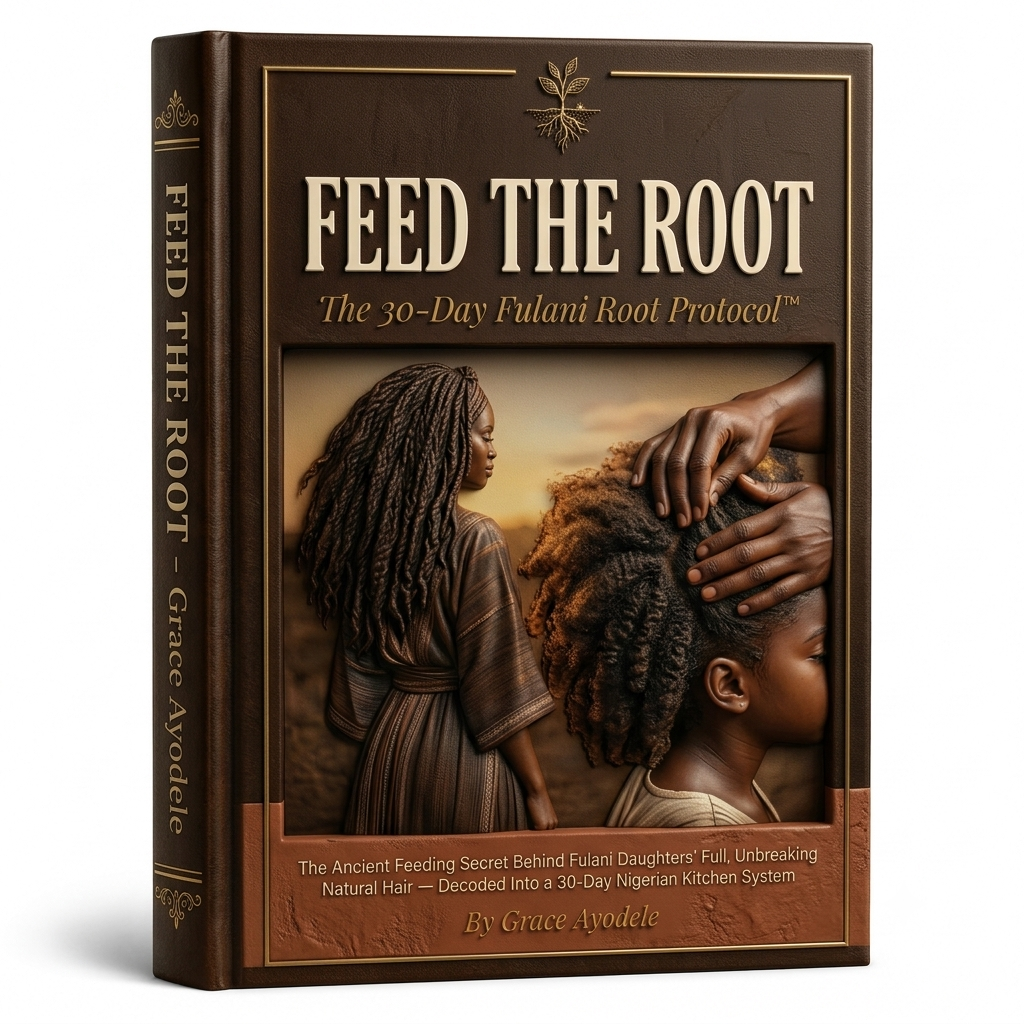
Everything Hajiya Rakiya taught me — four months of testing, refining, and documenting across more than fifty mothers and their daughters — written in plain, practical language so you can begin tonight. Available at any Nigerian market or Shoprite. Total weekly cost of the protocol ingredients: less than ₦3,500.
- The Fulani Secret Decoded — Why Fulani daughters' hair thrives while ours breaks, told through the three pillars of the Fulani diet and lifestyle that deliver exactly what the hair follicle needs — and why most Nigerian children in cities today are quietly running out of all three. (Pages 4–13)
- Understanding Both Problems as One — Why the breaking and the thinning edges are the same problem in two locations, why they must be addressed together rather than separately, and what to expect from each across the thirty days. (Pages 14–18)
- The At-Home Deficiency Assessment — A simple checklist that reveals where your daughter sits in the deficiency profile right now — which of the three nutrients is most depleted, based on her specific breakage pattern, her edge condition, her diet, and her daily sun exposure. (Pages 19–24)
- The 30-Day Fulani Root Protocol™ — Week by week. Day by day. Exactly what to feed, in what combination, in what order, across four weeks — to deliver iron, zinc, and Vitamin D to the follicle in the forms the body absorbs most efficiently. With shopping lists, daily actions, and measurable milestones for each week. (Pages 25–42)
- The Edge Recovery Roadmap — Written specifically for mothers whose daughters have thinning or bare edges. The honest timeline of edge recovery. What to do differently in Weeks 2 and 3. Why the edges come back last and how to keep going through the weeks when progress is invisible. (Pages 43–48)
- The Nigerian Kitchen Ingredient Map — Every protocol ingredient mapped to common Nigerian market and supermarket names. With affordable alternatives for each. How to access the nutritional benefit of fura da nono even if your daughter will not drink it. (Pages 49–53)
- The #1 Mistake That Resets Both Problems — The single most common thing mothers do when they begin seeing results — and exactly why it puts them back at the beginning. (Pages 54–56)
- The 30-Day Tracker and Maintenance Ritual — Daily logs for both breakage and edge recovery. The ten-minute weekly maintenance habit that keeps the loop broken permanently after Day 30. (Pages 57–62)
You do not need fura da nono. You do not need to go to Kaduna. You do not need a specialist. Everything in this protocol is available at your local market or Shoprite. Total weekly ingredient cost: less than ₦3,500.
Compare That to What This Problem Has Already Cost You
How Much Does the Guide Cost?
Here is what went into creating it.
A fair price for information that has already saved mothers more than that in products that never reached the root — would be ₦25,000. Easily.
But I know some of you reading this have already spent more than you want to say out loud. I do not want money to be the reason you stay in a problem that has a solution this straightforward.
So for the first 150 mothers who take action today —
Once You Click, Here Is Exactly What Happens
- You are taken to a secure payment page. Paystack, bank transfer, or card. Takes less than two minutes to complete.
- Your payment is confirmed instantly. No manual verification. No waiting for someone to check anything.
- The guide arrives on your WhatsApp AND your email within 60 to 90 seconds. Open it on your phone right now. Read Chapter 1 tonight. Begin the protocol tomorrow morning.
It is me, Grace Ayodele. As long as your payment confirms, your access is guaranteed. No delays. No exceptions. I read every message mothers send me.
What the First 30 Days Look Like
Real conversations from real mothers. Unedited.
WAIT — Before You Go, You Also Get These Two Free:
Complete your order today and these two companion guides come with it — at no extra cost:

The Nigerian foods that previous generations cooked — without knowing the science, but producing the results we now spend fortunes trying to recreate. Ugu, crayfish, ede, egusi prepared the old way, liver cooked every Tuesday without ceremony. Market names. Preparation methods. Why your grandmother's kitchen was a hair growth system and how to bring it back without turning your life upside down.

For the mother whose daughter will not eat liver, will not touch ugu, looks at beans like they personally offended her, and refuses every fish that is not the specific shape she has decided is acceptable. Twelve delivery methods. Hidden. Effective. No dinner table battles. No forcing. No crying. Just the nutrients arriving in the body through foods she already loves — and the hair that follows.
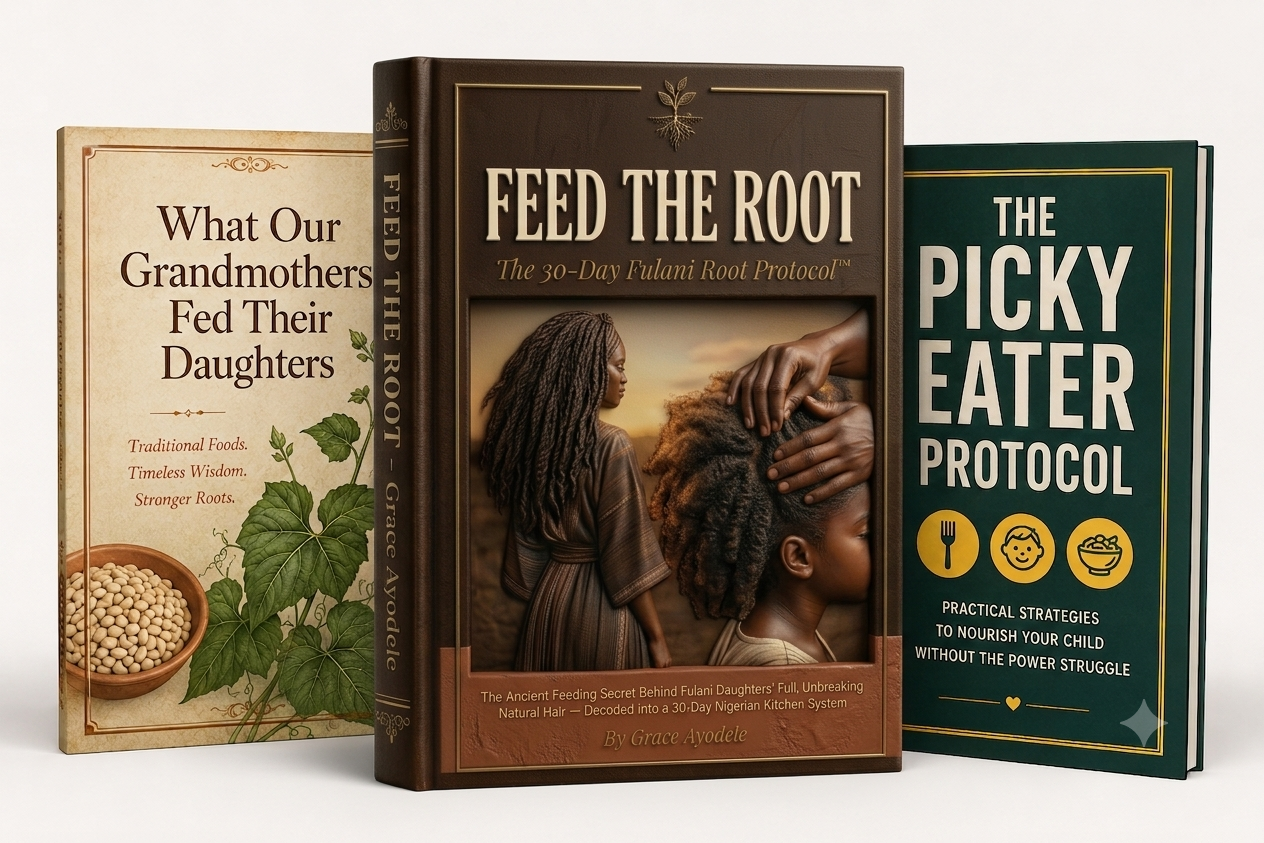
- Feed the Root: The 30-Day Fulani Root Protocol™ ₦12,500
- BONUS 1 — What Our Grandmothers Fed Their Daughters ₦6,000
- BONUS 2 — The Picky Eater Protocol ₦5,500
You Have Read This Far. Which Way Do You Go?
- The same hairstyle next Sunday. And the Sunday after.
- The hair grows to the same point and breaks. Again.
- The edges stay where they are — or retreat further.
- More money spent on products that land on the wrong part of the hair.
- Your daughter keeps watching. Keeps comparing. Stays quiet about it.
- You finally understand why everything else has not worked.
- The breaking begins to slow within days. The hair begins to stay.
- The edges begin to return. Slowly, then noticeably.
- You try a style you have not tried in years. It holds.
- Your daughter looks in the mirror and sees what she has been waiting to see.
🛡 30-Day Money-Back Guarantee
Follow the Fulani Root Protocol™ exactly as written for thirty days. If you do not see meaningful improvement — in the breaking, in the edges, or in both — send me a message and I will refund every naira. No forms. No lengthy explanation. Just a message. I have offered this guarantee from the beginning and I have not had to honour it for a single mother who followed the protocol completely. That is how confident I am in what Hajiya Rakiya taught me.
One last thing before you decide.
Picture yourself one month from today.
Are you standing behind your daughter with a comb — and not dreading what you will find on the floor?
Is she coming to you on a Sunday morning asking for the style she stopped asking for?
Are you looking at her temples — those temples — and seeing something there that was not there a month ago?
Is she looking in the mirror and seeing something she is satisfied with?
Now picture yourself one month from today if you close this page. The same comb. The same floor. The same style that hides what is not there. The same quiet in the car on the way home from the school where the other girls wore their hair differently.
The difference between those two pictures is a decision you make in the next sixty seconds. Hajiya Rakiya said the body knows how to restore what it lost. It just needs to be given what is missing. Give it that. Tonight.
Still hesitating?
Ask yourself honestly: is it that you do not believe this will work? Or is it that you have been disappointed so many times that letting yourself hope again feels like a risk you are not sure you can take?
I understand that. Every mother who has spent money on things that did not work carries that weight when she considers trying one more thing. I carried it too.
But there is a thirty-day money-back guarantee standing between you and that risk. Follow the protocol for thirty days. If nothing has meaningfully improved, you get every naira back. The only real risk is another month of the same hairstyle.
Your daughter's follicles are not broken. They are hungry. The answer is in your kitchen. It just needed someone who sat beside a calabash at Kasuwan Barci market to tell you where to look.
Stop hesitating. Choose her. This is what mothers do.
I Choose Her — Start Tonight for ₦7,500P.S. — The thirty-day money-back guarantee is real. Follow the protocol completely for thirty days. If the breaking has not reduced and the edges have not responded, message me and I refund everything. No forms. No waiting. This has never happened for a mother who followed the protocol as written.
P.P.S. — The ₦7,500 price is for the first 150 mothers who complete payment today. After that, the price returns to ₦12,500 and both bonuses leave. Once those 150 spots are filled, I cannot hold the price any longer.
P.P.P.S. — Hajiya Rakiya said: the body knows how to restore what it lost. It just needs what is missing. Every day you wait is another day the follicle does not receive what it needs. Every day you start is a day closer to the Sunday morning you have been waiting for.
Questions Mothers Ask Before They Start
My daughter has both problems — hair that breaks AND thin edges. Does this address both?
Yes. And understanding why is important: the breaking and the edges are not two separate problems. They are the same nutrient deficiency expressing itself in two locations. The hair breaks because strands are built without enough structural material. The edges thin because the hairline follicles — the most sensitive on the entire scalp — are the first to slow down when the body's supply is depleted. The Fulani Root Protocol™ addresses the root cause, so both symptoms improve together. Typically the breaking responds first, around Days 10-14. The edges follow, becoming visible around Days 18-25. The Edge Recovery Roadmap in Chapter 5 gives you the complete honest timeline and what to watch for each week.
Do I need fura da nono? My daughter will not drink it.
No. Fura da nono is the origin of the knowledge — the food that led to understanding what the hair follicle actually needs — but it is not a requirement of the protocol. The Fulani Root Protocol™ delivers the same three nutrients through alternative Nigerian foods available at any Shoprite, Spar, or local market. If your daughter accepts fura da nono, Chapter 4 includes it as an option. If she does not, the protocol works completely without it. Total weekly ingredient cost either way: less than ₦3,500.
My daughter is a very picky eater. Will this still work?
This is the most common concern after mothers buy the guide — which is exactly why Bonus 2 exists. The Picky Eater Protocol gives you twelve specific delivery methods for getting the three key nutrients into a child who refuses liver, greens, beans, or fish. Hidden in foods they already love. No battles at the table. No forcing. No tears. Order today and it comes included free.
How long will the edge recovery take specifically?
The edges take longer than the general breakage to respond because the hairline follicles were depleted first and recover last — exactly as Hajiya Rakiya described: last in, last out. Most mothers begin to feel the earliest new edge growth between Days 16 and 22 — fine, almost invisible hairs along the temple that you feel before you can see them. Visible improvement that is noticeable when styling typically appears between Days 25 and 35. For daughters who have had sparse or bare edges for more than two years, the timeline may extend to 45-60 days. The Edge Recovery Roadmap in Chapter 5 tells you exactly what to look for each week so you do not give up during the weeks when progress is not yet visible.
Is the money-back guarantee real?
Completely real. Follow the protocol exactly as written for thirty days. If there is no meaningful improvement in the breaking and no response in the edges, send me a message and I refund everything. No forms. No lengthy process. The only condition is that you genuinely followed the protocol as written — not partially, not occasionally, as written. I am confident enough in Hajiya Rakiya's wisdom, and in the four months of testing that went into this guide, to offer this guarantee without hesitation.
Why will this work when everything else has not?
Because everything else addressed the hair from the outside — products, techniques, supplements, protective styles. All of them reached the strand. None of them reached the follicle, which sits three to four millimetres below everything you can touch. The Fulani Root Protocol™ addresses the follicle from the inside — by changing what the blood delivers to it every day. This is not a better product. It is a completely different approach that targets the actual location of the problem. Fulani daughters have been proving that this approach works for five hundred years. The protocol translates that proof into thirty days and a Nigerian kitchen. That is the difference.
Leave a Comment